Description
Topics
Half Adder
Full Adder
BCD to Excess 3
Binary to Gray
BCD Adder
Multiplexer
Demultiplexer
1-bit Comparator
2-bit Comparator
Parity Checker
Parity Generator
Flip-Flop Conversion
Up Counter
Down Counter
3-bit Up/Down Counter
Decade Counter
Sequence Detector
Shift Register
ASM Chart
Flip flop conversion
Conversion of D Flip Flop to SR Flip Flop

D is the actual input of the flip flop and S and R are the external inputs. Eight possible combinations are achieved from the external inputs S, R and Qp. But, since the combination of S=1 and R=1 are invalid, the values of Qp+1 and D are considered as “don’t cares”. The logic diagram showing the conversion from D to SR, and the K-map for D in terms of S, R and Qp are shown below.

Conversion of JK Flip Flop to T Flip Flop

J and K are the actual inputs of the flip flop and T is taken as the external input for conversion. Four combinations are produced with T and Qp. J and K are expressed in terms of T and Qp. The conversion table, K- maps, and the logic diagram are given below.
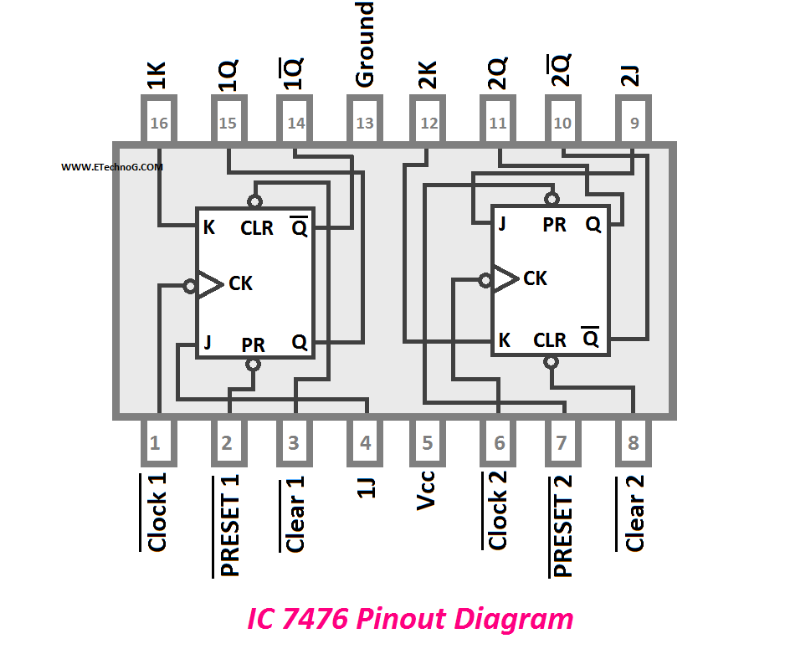
In electronics, flip-flops and latches are circuits that have two stable states that can store state information – a bistable multivibrator. The circuit can be made to change state by signals applied to one or more control inputs and will output its state. It is the basic storage element in sequential logic.
Points To Remember:

  • Components: Input and output.
  • Types:D to SR and JK to D
Pin Diagram